
Where it is, honestly
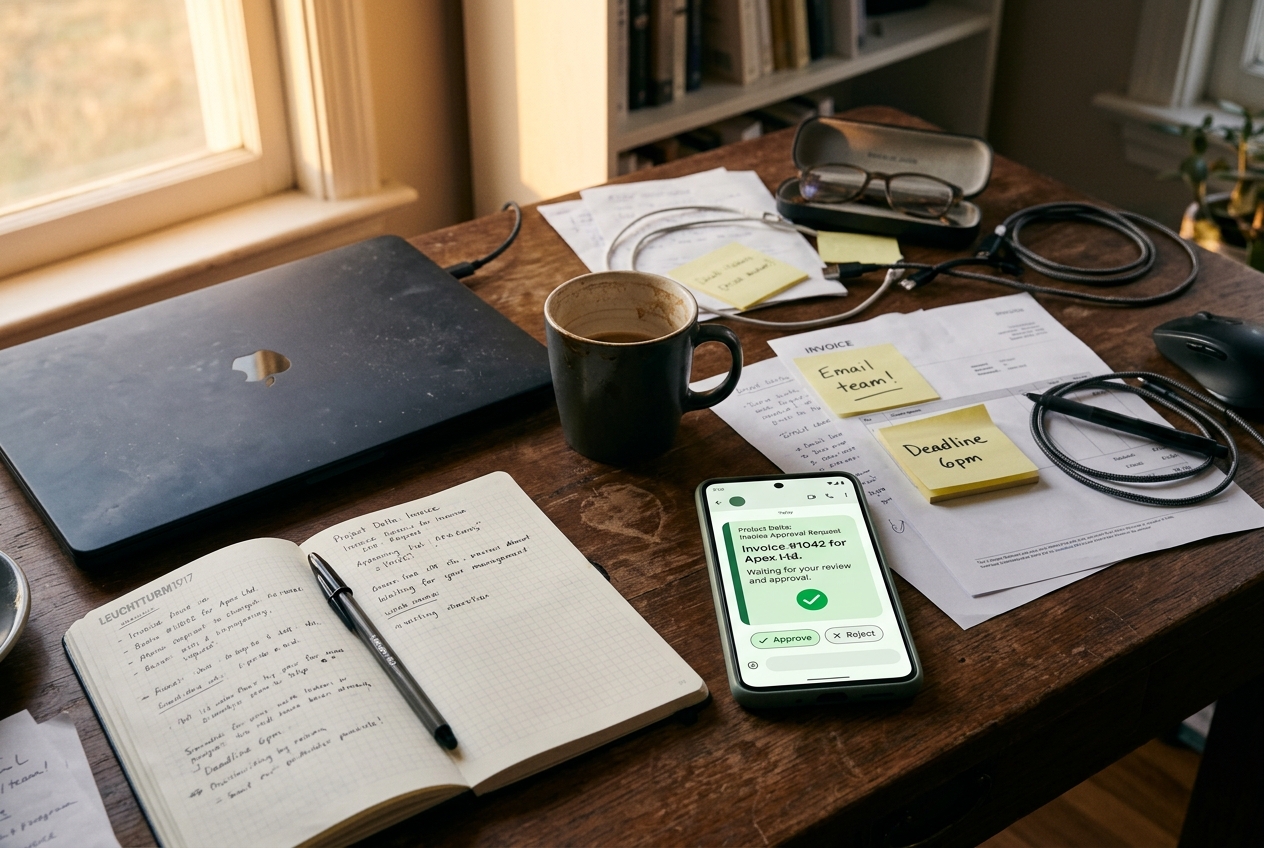
The last piece I wrote was a day with it: three ordinary asks, and the point at each one where the assistant stops and waits for me. This one is the opposite of a day. It is the stock-take.
Here is where it actually is: what is in real use, what is new and barely tested, what is not built, and why the gates sit where they do.
I would rather round down and be believed than write a product page that implies more than it can stand behind.
Two users, and no customers
It is in real use by two people. One of them is me. The other is a colleague in the business who has started using it to set up the warm introductions for our free guided sessions.
It is not open to other customers, and we cannot take you on today. Pricing is not set, and I will not invent a number to make the page look finished. The web app is built and parked; Telegram is the door in use.
What is in real use
Mail. I ask whether anyone has replied to what I sent last week. It reads the mailbox, tells me who replied and what about, and drafts an answer to each. The draft arrives on a card. Nothing leaves my address until I press Approve.
Leads and outreach. It searches for local businesses, checks each one against the public companies register, keeps the ones that fit as leads, and drafts a first email from my own template. I approve a batch. It sends within a daily limit, skips anyone on my do-not-contact list, and brings the replies back to me. I run one cold-email campaign this way, and it is the clearest example of the work happening inside a boundary I set.
Records, tasks and dates. It holds my contacts, organisations, leads, tasks, reminders, decisions and key dates, and a memory of what I have told it about how I work. Adding a record is free. Changing or removing one I already hold arrives on a card with the before and the after.
Research. It searches the public web and reads a page I give it. Reading public pages needs no approval. The first time its workspace reaches a site it has not used before, it asks.
Finding what's on. I ask what business events are on near me this week. It checks the Chamber calendar, the BCS listings, the region's tech network and the government's free business sessions, and hands me a short ranked list: date, venue, in person or online, price, and why each one fits.
Smaller jobs. It reads the funding page I send it and says whether it is worth my time. It keeps a round-up of the news sources I follow. It looks a person up before I meet them. All of it runs inside the same boundary.
What is new, and what is not built
New means built and running, with very little real use behind it. Background jobs are here: a job can run at a set time or on a repeating timetable, and a long one runs in the background and tells me when it ends. Files you send it are here: a PDF arrives as text it can work from. The agent it can run on your own computer or server is here, and its container reads went live on production on 22 November. Finance records are built too, money in and out in any currency, with categories and recurring costs, but they are not part of what I use, so I would not sell you that.
Not built at all: invoices in both directions, a way for you to export or delete your own data yourself, voice notes, and the assistant reading photos.
Where it runs, and how your work is kept apart
It runs on one server we operate ourselves. Your records, mail copies, documents, conversations and approvals live in a single database there, and every record carries its owner. Each person's assistant works in its own sealed workspace, on its own private network, and one customer's workspace cannot see another's.
Your mail and calendar stay with your own provider; we read them through the connection you set up. To work on your request, the text of it and the records it needs go to an AI model that we buy as a service. We use open-weight models rather than one supplier's proprietary one, so the model can be changed without the product changing underneath you.
The workspace has one way out to the internet, and that gate records every request and blocks known-bad sites. Passwords and keys for outside services are held there, so the workspace never holds them.
Why the gates sit where they do
The boundary is the product, so it is worth saying why each piece of it sits where it does.
Reading is free; acting waits. Reading my mail, my records and the public web, adding a record, taking a note: none of it waits for a card, because none of it acts on the world. The moment the work would leave the building, send something, spend something, change something, remove something, it stops and asks.
Adding is free; changing waits. A new record is information, and if it is wrong it is one deletion away. A change to a record you already hold quietly rewrites something you were relying on, so it shows the before and the after and waits for your press.
Only a person presses. This is the one I would defend hardest. The assistant cannot press its own card, and a program holding an access key cannot press on your behalf either. An approver that can approve itself is not an approver. It is a delay dressed up as a control.
The first time it reaches a new website, it asks. It should not silently start talking to strangers because a job needed a page.
It keeps the record. Every AI request is logged with what the assistant was given, what it did and what it cost. Every card is kept with its decision. That record is the reason I am comfortable handing it real work. If I cannot see what it did and why, I cannot stay in charge of it.
What I will not do
I will not say it is further along than it is. If that costs a customer who wanted something finished, it is the right trade to make.
I watched this class of software arrive in small firms without a contract and without an announcement. One person tried a chatbot, it saved an afternoon, and within a year it was part of how the quotes get written, load-bearing before anyone asked whether it should be. An assistant that can send, spend and change things makes that gap concrete, and the honest answer to it is a gate you set and a record you can read, not a smoother demo.
The capability is not the hard part any more. Where the line sits is, and whether you can see what happened on the other side of it.
When we can take on other customers
If this is the shape of tool you want in your own firm, the useful first step has nothing to do with buying anything. Write down what the AI in your business already does. Where it sits. What it can see. What it can send. Who checks the output. What happens when it gets it wrong. That is an afternoon, and it costs nothing.
The ten checks in the free guide are a place to start. They were written for continuity rather than for AI, but the discipline is the same: name the thing, name the owner, name what happens when it fails. To apply it to your own firm, the Guided Session is the next step.
And if you would like to hear when we can take on other customers, leave a few details at lamontworks.uk/register-interest. We will tell you when that changes.
It is in real use, by two people, and that is the whole of what I can claim today. This is a start, not a launch.
Want the ten checks done for your firm?
Ninety minutes on a call or on-site, you leave with the answers on paper.